

Go Back
Asset Allocation Strategy
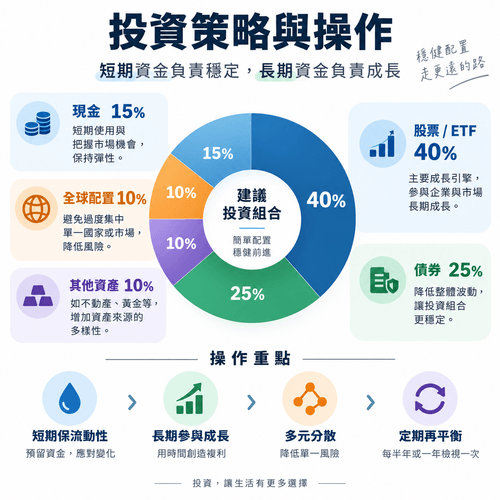
Investing doesn't require choosing between 'short-term stability' and 'long-term growth.' Good asset allocation involves first separating funds based on their purpose—allocating some to maintain liquidity and flexibility, while allowing others to continuously participate in market growth. Short-term funds are primarily for daily needs, emergency reserves, and resilience during market fluctuations; long-term funds, through stocks, ETFs, bonds, and global asset allocation, allow assets to grow gradually over time through compounding. Operating both simultaneously can reduce the need to sell long-term investments prematurely due to short-term cash requirements.
More Details
Short-term funds are responsible for stability, while long-term funds focus on growth.
- Stocks/ETFs 40%: Serve as the primary growth engine, participating in the long-term growth of companies and markets.
- Bonds 25%: Reduce overall volatility and add an extra layer of stability to the portfolio.
- Cash 15%: Reserve for short-term needs and market opportunities, providing flexibility.
- Global Allocation 10%: Avoid over-concentration of assets in a single country or market.
- Other Assets 10%: Enhance diversification of asset sources and further spread risk.
Prioritize liquidity in the short term → Participate in growth over the long term → Diversify across asset classes → Rebalance periodically.
